
Climate change is often described as a universal crisis. In reality however, it is a profoundly unequal one. Its impacts, and ability to adapt, are shaped by power – by who has access to land, resources, decision-making, and safety, and who does not. When examined through a feminist lens, climate change reveals itself as anything but gender-neutral. Women, girls, and gender-diverse people bear the heaviest burdens of the climate crisis.
Historically, women have had lesser access to resources such as land, agricultural inputs, decision-making structures, technology, and training compared to men which is directly linked to the global implications of inequalities and disparities that weaken women’s ability to adapt to climate change.
Also, women are proportionally more dependent on threatened natural resources which makes them more vulnerable than men. Evidence shows that the scarcity of forest resources reduces the incomes of women who sell these products, leaving them more exposed to the risks of climate change.
Working at the intersections of gender and climate, Mega Maskey, a climate justice activist and practitioner from Nepal with over six years of experience in grassroots organising and advocacy, cites an example:
“Water collection is still largely women’s responsibility in rural areas. As water sources dry up, women, often mothers and young daughters, must spend more time and travel further to collect water. This affects girls’ education because they’re pulled out of school.”
When climate-related water scarcity forces longer walks, it adds more workload for women, and deprives girls of educational opportunities. Moreover, climate change is predicted to exacerbate the burden of water collection on women’s welfare globally with physical strain and mental distress.
Likewise, when women are compelled to travel long distances for water, firewood and other resources to support themselves and their families, they are more prone to attack and abuse.
Besides, natural disasters too push women to the brink of vulnerability. The two continuous major earthquakes of 2015 took the lives of thousands of people in Nepal and the post-earthquake situation made thousands of women targets of human trafficking.
Now, if we zoom in the focus beyond cisgendered heterosexual folks, then the impacts pertaining to nonbinary, trans and genderdiverse people are disproportionate too. But their struggles have been overlooked for far too long.
“Gender-diverse people are excluded from climate relief and support systems because response systems often assume a gender binary (men/women), making it harder to access shelters, aid, and health care respectfully.” Mega states.
Yes women are systematically forced to to bear the brunt of the consequences of climate change, but women with layers of intersectional identities are facing extreme vulnerabilities. Climate change impacts trans women, Dalit women, women from lower socioeconomic backgrounds and women with disabilities even harder.
Women are excluded from decision making roles and often are made to resort to compromise agency even when they are suffering the most. Their potential continues to be undermined in deciding when and how to overcome the vulnerabilities they face.
But, women belong to the decision making rooms and their representation and active participation is not an option, but a necessity. In order to innovate and secure adaptation and mitigation measures, women should be at all levels of leadership and across all sectors of society.
When the climate crisis disproportionately impacts women, shouldn’t they be at the forefront of its solutions? Women have only been owed equity. And to truly address this persisting gap of climate justice inextricably linked with gender, as it seems, requires a feminist approach.
So what does a truly feminist approach to climate justice look like?
“A feminist climate justice approach asks: how are women affected? How are different groups of women differently affected? How do they benefit? Where are their voices? It’s not just about gender quotas. It also involves decolonial thinking. Feminism talks about liberation: anti-capitalist, anti-oppression, decolonial values. Western, standardised approaches often ignore indigenous relationships with land, people, and nature.” Mega elaborates and adds,” A feminist climate approach believes in disrupting oppressive systems but also in caring and sustaining the movement.”
But, challenging the system is not an easy task. And it becomes way more hostile for women.

Image Caption: Mega Maskey, climate justice activist and practitioner (Supplied).
“Women climate activists are often not taken seriously, our concerns are sometimes taken as childish and other times not important enough. In policy intervention or policy advocacy spaces, there is clear favoritism toward men, who gain easier access to power, opportunities, and influence, while women receive fewer chances despite our expertise.”
Mega shares and adds harrowing reality.
“And then there’s the public backlash. I’ve received direct death threats for speaking out, my friends have received rape threats. Male activists are not easily targeted like that. Most climate activists I know are women, yet we face the worst misogyny.”
Going through all that makes burnout inevitable, and this is where the feminist approach of extending care, solidarity, and community keeps the movement alive.
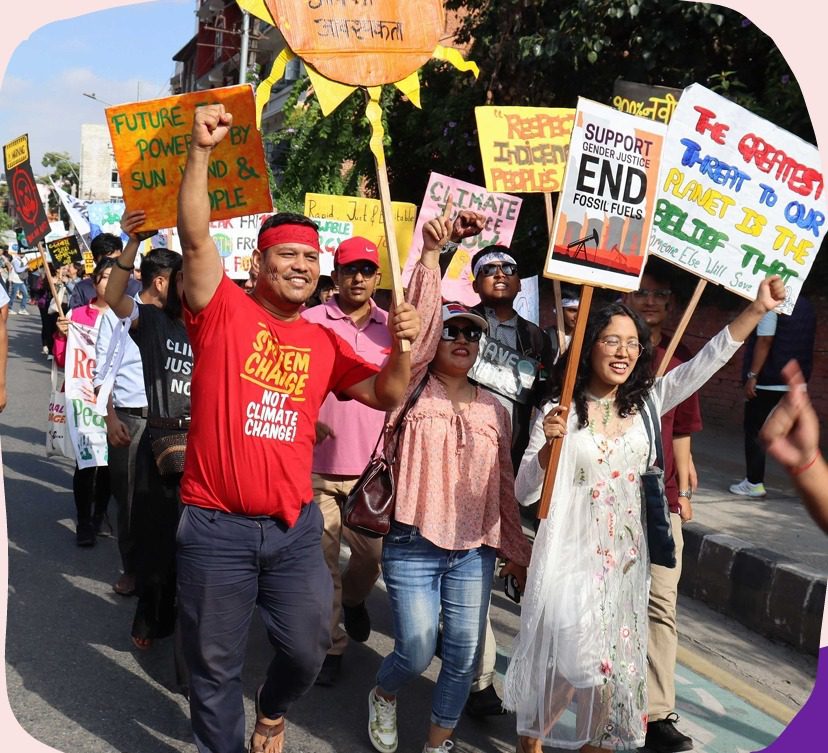
Mega as seen on a climate justice march.
But Mega believes collective care and truly practicing solidarity in climate movements is what is lacking even though everyone talks about inclusivity and intersectionality.
“Mainstream spaces, especially government-led ones, are similar to political representation. Numbers look good on paper, but the power dynamics are still not equitable.”
Men always have the upperhand when the patriarchal system favours them and this influence of patriarchy, a discriminatory social structure, strongly determines the national and sectoral policies, strategies and programmes.
And when it’s not men at the national-level consultations, it’s still mostly the same kinds of women speaking, from larger organisations, with privilege; Kathmandu-centric, upper-caste, upper-class women.
Feminist climate justice is not just about addressing structural inequality rooted in patriarchy but also about recognizing other systems of domination and dismantling them as well.
Channeling the feminist justice lens, Mega has been a part of campaigns that are gender-transformative through which real impacts were created.
As someone who also co-founded Harin Nepal, a youth-led climate collective promoting intersectional environmentalism, she has been part of mobilizing thousands of young people on issues of climate, gender, and democracy since 2018.
“By integrating feminist and intersectional lenses in our campaigns, we’ve run workshops on gender and climate for younger women and students, teaching local-level interventions, accessing fundamental rights and environmental rights, consulting in national policies on GEDSI (Gender Equality, Disability, and Social Inclusion) lenses.” Mega explains.
She now runs Action for Resilient Adaptation and Nature-based Energy Alternatives (ARANYA), a non-profit organization working on climate adaptation, carbon mitigation and just energy transition.
Mega is also a member of Global Shapers Kathmandu Hub since 2021, where she has led projects on climate education, and climate resilient agriculture for youths. Her work bridges indigenous knowledge, feminist movements, and youth empowerment, advancing energy and environmental justice in Nepal and the wider Asia-Pacific region.
Based on her experiences, women’s reception to climate activism she was a part of has been positive because it’s about their liberation and empowerment. And for Mega, movement spaces led by women definitely feel different.
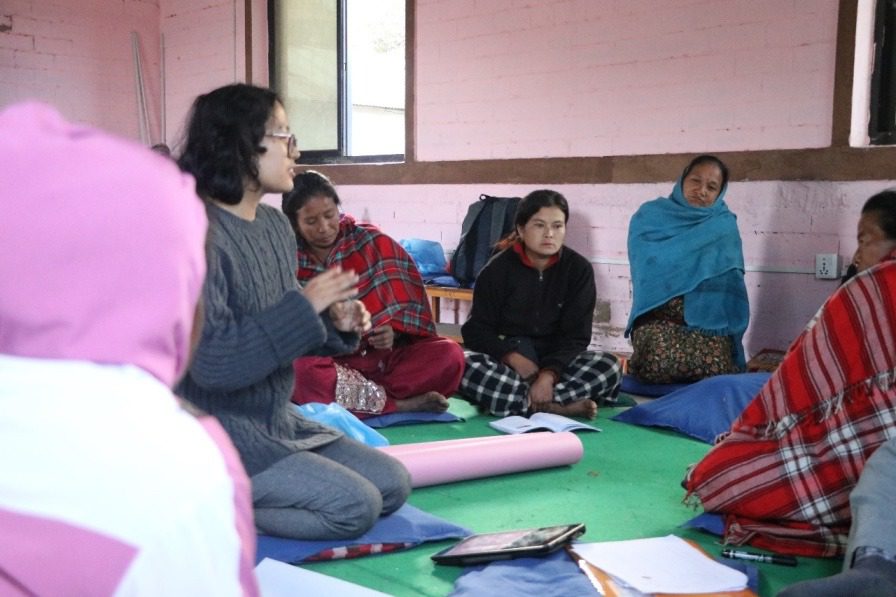
Mega facilitating a workshop on Advocacy for Feminist Just Energy Transition. Image Credit: Sara Tunich Koinch
Feminist climate justice is also about decolonisation, but Mega claims it is an on-going, reflexive and learning journey.
“Our approach is to build relationships, be honest, acknowledge mistakes, and constantly try to make the movement more inclusive. We still have a lot to learn.” Mega speaks with honesty.
“Measuring success in activism is difficult. We don’t have numbers or formal “results.” But consistent messaging, public conversations, meetings, and even social media posts shift perspectives. That’s the impact.” Mega says.
Upon being asked if she considers herself a grassroots climate leader, Mega said she is still working towards truly becoming one.
As a Newa woman from Patan with a history of state-sanctioned dispossession and Brahminical colonisation, Mega understands grassroots struggles, but she also recognizes her privilege as someone born and raised in an urban space.
“Grassroots work requires deeper engagement. I try to be as grassroots as possible, but I acknowledge my limitations. Someone from a remote hilly village , for example, would have very different experiences” she adds a feminist lens.
This is why it becomes imperative to examine the climate crisis through the lens of feminism. And only by doing so can climate justice move beyond rhetoric toward transformation.
In practice, this means designing climate policies that centre the rights of women, girls, and gender-diverse people across four key dimensions:
This begins with recognition. Climate policies must recognise and value women’s rights, labour, and knowledge, particularly those of groups facing multiple and intersecting forms of discrimination that weaken their ability to respond to climate impacts.
Likewise, it also requires redistribution. Resources must be shifted away from fossil fuel–dependent economies and toward systems that prioritise human dignity, care, and planetary well-being.
Equally important is representation. Women and other marginalised groups must have meaningful participation and real decision-making power at all levels of climate governance, not just symbolic inclusion.
And lastly, feminist climate justice demands reparations. Climate justice must acknowledge that the Global North bears the greatest responsibility for historical and ongoing emissions, and must repair the harms caused while ensuring they are not repeated.
In a nutshell, climate change might begin with something as simple as a longer walk for water. Feminist climate justice asks why that walk exists, and who has been forced to take it, and at what cost.